As it happens to some extent world over to term "Nuclear Science" Russian
term Nuclear Physics (sounds: "Yadernaya fizika" - in English transliteration
and "Jadernaja fisika" - in German-oriented transliteration) has rather
indeterminate meaning covering such fields as Nuclear Physics proper, Particles
Physics, Cosmic Rays, Accelerators and Nuclear Reactors Physics as well
as Applied aspects of these fields. Sometimes it stands for only Physics
of Nuclei but in general it has mentioned accumulative meaning...
- Usage of titles
It differs considerably from West countries standards. Please, pay attention, that:
- There are in Russia such scientific degrees (in order of arising level) as: candidate of such and such sciencies (e.g. "candidate of physical and mathematical sciencies" and so on, even - "...of military sciences"; then doctor of such and such sciences; there is also title "professor", which is an additional to doctor in case the person achieved some necessary level in any kind of educational merits, not only in purely educational institutes or universities.
- Usually these degrees correspond in the following way:
- candidate = Dr. or PhD.
- doctor = Professor
- Short Comments to adequate transliteration
Avoiding fine linguistic distinctions the basic guidelines and grounds for them look like the following:
As Slavonic Latin scripts for languages very close in phonetics to Russian
i.e. Polish, Czech and Slovak, which exist a lot of centuries, should not
be ignored we are to adopt existing in these languages transliterations
for two conflicting Russian sounds. The problem is the following one.
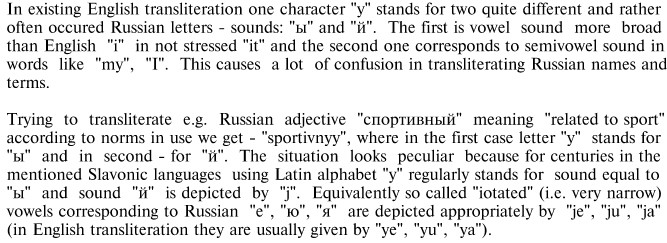
To read more adequate transliteration you may make use of the following short
ADEQUATE PRONUNCIATION GUIDE
|
|
|
| a - as in "car" | ch - as in "chat" |
| ja - as in "yard" | sh - as in "show" |
| e - broad sound as in "map" | shch - as in "sure", but pronounced
more energetically |
| je - as in "yet" | kh - very hard and strong "h"
as in Scottish "Loch" |
| i - in most cases as in "see" | ts - as in German "zu" |
| ju - as in "you" | zh - as in "vision" |
| y - more broad sound than
in unstressed "it" |
|
|
|
|
| j - as last sound in "I", "my" | ' - placed after consonant makes
it soft
e.g. l' - as in French "l'homme", "la" et cet. |
` - placed before accented syllable (only in thorough transliteration!) |
Besides aforementioned characters (group of characters) other are pronounced
close enough to their English equivalents. See Russian alphabet in the
end of this file.
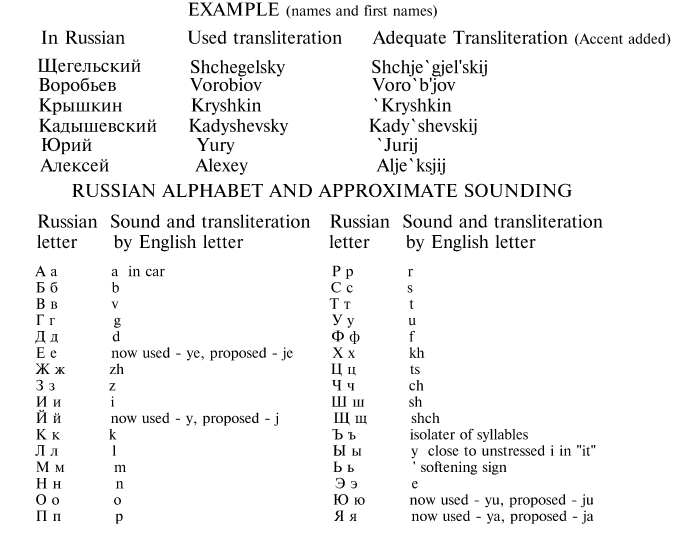
 in combinations ЫА и ЫУ to differ them from Я and Ю.